Lesson 2 of 10 · 3 min · Mind
The white bear problem: why pushing thoughts away backfires
Pushing a thought away brings it back. One simple swap works better.
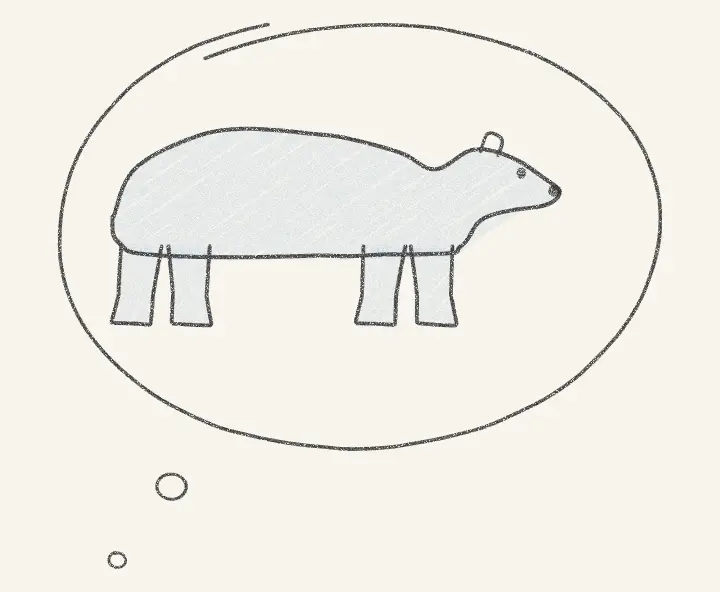
Try this for ten seconds: do not think of a white bear. Anything you like, only not a white bear.
The writer Fyodor Dostoevsky noticed it in 1863: give yourself the task of not thinking of a polar bear, and the cursed thing will come to mind every minute.
In 1987, psychologist Daniel Wegner tested it. Students talked aloud for five minutes while trying not to think of a white bear, and rang a bell each time it came to mind. The bear came back more than once a minute.
Then came the rebound. When they were later asked to think of the bear, the students who had pushed it away first thought of it more than students who had been free to think of it from the start.
One thing helped. In a second experiment, students got a single other thing to think of whenever the bear showed up: a red Volkswagen. The bear still came by, but the rebound afterwards shrank.
So when the voice says something you would rather not hear, arguing it away tends to backfire. Let it be there, and turn to one chosen thing: your breath, the room, the task in front of you.
Quick question
Someone keeps replaying an awkward moment. What tends to bring it back even more?
- Trying hard not to think about it
- Noticing it, then turning to one chosen task
- Writing it down
Show the answer
Trying hard not to think about it
Pushing a thought away keeps the mind checking whether it is gone, which brings it back. One chosen focus gives attention somewhere to go instead.
Keep this one
Fighting a thought feeds it. Give your mind somewhere to go.
Where this comes from
Wegner, Schneider, Carter and White 1987, Journal of Personality and Social Psychology 53 (Paradoxical effects of thought suppression). Dostoevsky, Winter Notes on Summer Impressions, 1863. Bar heights in the drawing are an illustration.