Lesson 1 of 10 · 3 min · Mind
Alone with your thoughts: why sitting still is so hard
Most people find it hard to sit with their own mind. That is normal, and it is where this path starts.
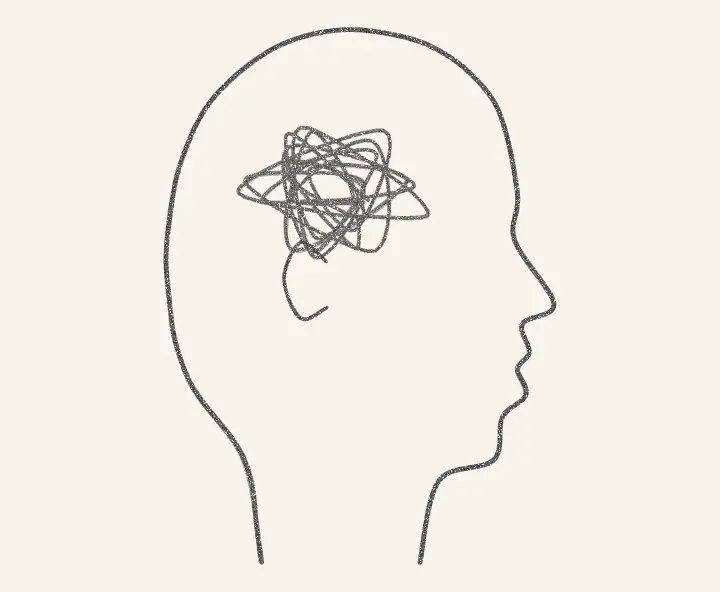
In 2014, psychologists asked people to sit alone in a bare room for 15 minutes and simply think. The only thing within reach was a button that gave them a mild electric shock.
The study only counted people who had said beforehand that they would pay money to avoid that shock. Left alone with their thoughts, 12 of the 18 men and 6 of the 24 women pressed the button anyway. One man pressed it 190 times.
Our minds drift all the time. A Harvard study asked 2,250 adults on their phones, at random moments, what they were thinking about. In 46.9% of those moments, it was something other than what they were doing.
And they were less happy while their minds wandered. Even drifting off to something pleasant made them no happier than staying with what they were doing.
Not everyone hears a voice, though. When 30 students were beeped at random moments, inner speech was there in about a quarter of them. Some never heard it at all; for others it was there three times out of four.
The voice in your head is useful. It plans, remembers and rehearses. The trouble starts when it loops on the same worry, and you forget that you are the one listening.
This path is a set of small tools for that loop, each tested in studies. Most take a minute or less, and you can use them on a bus, at a desk or in bed.
Quick question
In the 2014 study, what did many people choose over 15 minutes of just thinking?
- Leaving the room early
- A mild electric shock
- Falling asleep
Show the answer
A mild electric shock
Two thirds of the men and a quarter of the women shocked themselves at least once, after saying they would pay to avoid exactly that shock.
Keep this one
A restless mind is normal. You can learn to steer it.
Where this comes from
Wilson, Reinhard, Westgate, Gilbert and others 2014, Science 345 (Just think: the challenges of the disengaged mind). Killingsworth and Gilbert 2010, Science 330 (A wandering mind is an unhappy mind). Heavey and Hurlburt 2008, Consciousness and Cognition 17 (inner speech in 26% of samples, from 0% to 75% per person).