Lesson 3 of 5 · 3 min · Behavior
The number that sticks
A random number can move your guess. So can the price you paid.
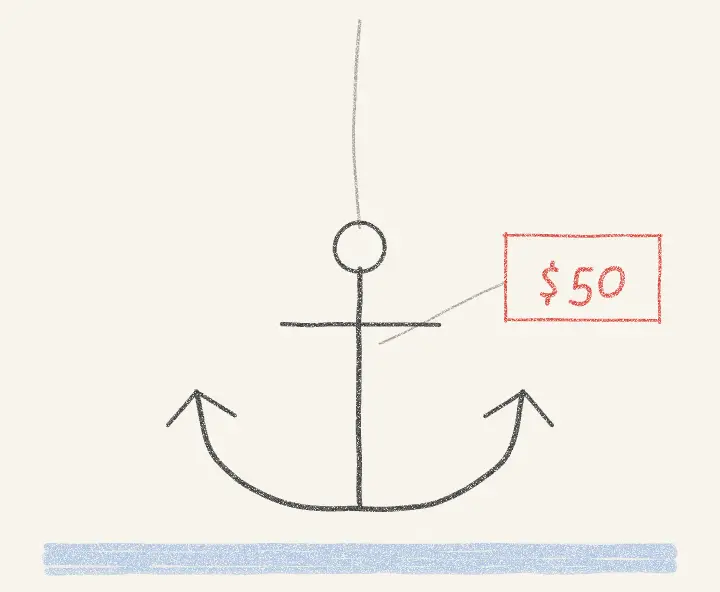
In 1974 the psychologists Amos Tversky and Daniel Kahneman spun a wheel of fortune in front of people. It was rigged to stop at 10 or at 65.
Then they asked: what percent of African countries are in the United Nations? The typical guess after a 10 was 25%. After a 65, it was 45%.
The number meant nothing, and everyone knew it. It still pulled their answer toward it. This is called anchoring.
In investing, the strongest anchor is the price you paid. You bought at $50. It is now $30. It feels cheap, or it feels like a debt the stock owes you.
The market does not know what you paid, and it does not care. The only useful question is what the business is worth from here.
Other anchors to watch: the all time high, a round number, the first price target you read. Before you decide, ask where your number came from.
Quick question
You bought a stock at $50. It now trades at $30. What should decide whether you keep it?
- Getting back to $50 first
- What the business is worth from here
- How much you have lost
Show the answer
What the business is worth from here
Your purchase price is history. Keep a stock if you would buy it today at $30, not because you want your money back.
Keep this one
What you paid is not what it is worth.
Where this comes from
Amos Tversky and Daniel Kahneman, “Judgment under Uncertainty: Heuristics and Biases”, Science, 1974. The figures are the median guesses they report.