Lesson 2 of 5 · 2 min · Behavior
Why losing hurts twice
Your brain keeps a lopsided scoreboard.
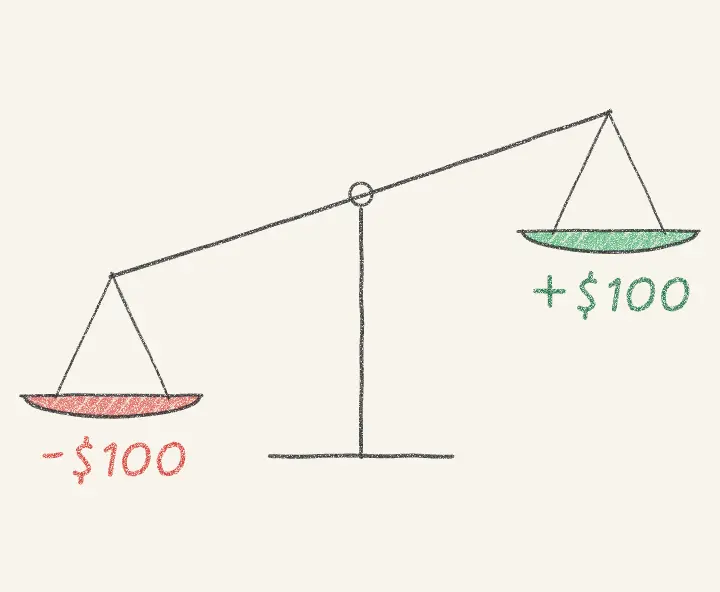
A coin flip. Tails, you lose $100. Heads, you win $150. Would you take it? Most people say no.
On average the bet pays you $25 a flip. It is a good bet. It just does not feel like one.
The psychologists Daniel Kahneman and Amos Tversky measured this. A loss hurts roughly twice as much as an equal gain feels good.
In investing it shows up as selling winners too early, and holding on to losers for too long, waiting to get back to even.
It is also why checking your portfolio every day feels bad. Stocks fall on almost half of all days, and each fall stings twice.
Quick question
Which habit makes loss aversion hurt the most?
- Checking your portfolio every day
- Checking it once a year
- Owning a broad index fund
Show the answer
Checking your portfolio every day
The more often you look, the more losses you see, even when the long run is going fine. Looking less is a real strategy.
Keep this one
Look less often. Losses shout.
Where this comes from
Kahneman and Tversky, “Prospect Theory”, Econometrica, 1979. The factor of about 2 is from Tversky and Kahneman, “Advances in Prospect Theory”, 1992, who estimated 2.25. Benartzi and Thaler, “Myopic Loss Aversion and the Equity Premium Puzzle”, 1995. The calendar is an illustration, not real data.