Lesson 5 of 12 · 3 min · Valuation
Return on capital
How much profit each dollar in the business earns.
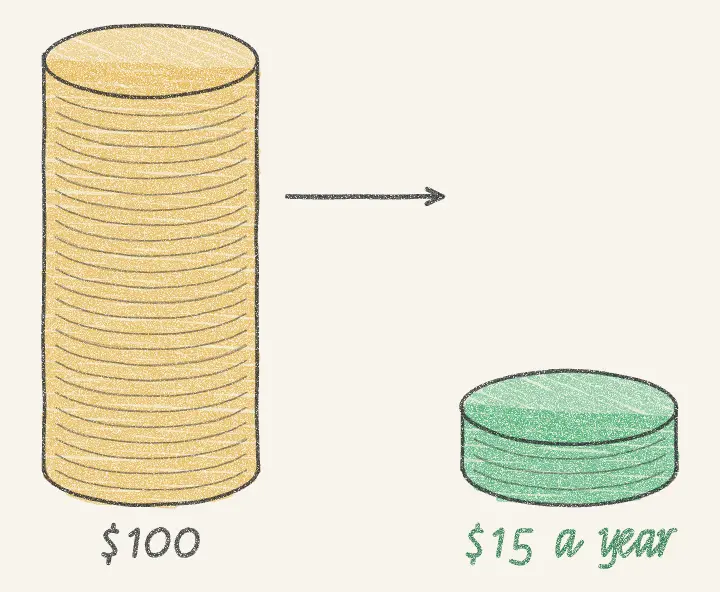
Every business needs money put in to work: stands, lemons, fridges, cash in the till. That money is its invested capital.
Return on invested capital, or ROIC, asks a simple question: for every dollar put in, how much operating profit comes out each year, after tax?
Lemon Co’s $2.5 million operating profit is $1.875 million after 25% tax. The business runs on $12.5 million of capital. That is a return of 15% a year.
Now picture a rival, Sour Inc, making the same profit but needing three times as much capital to do it. Its return is only 5%. Same profit, much worse business.
Higher is better. As a yardstick, compare it with rivals and with what money costs the company, often somewhere around 8 to 10% a year. Earning 15% on every new stand, Lemon Co can grow and create value. At 5%, growth barely pays.
Quick question
Two companies each earn $10 million a year. One needs $50 million of capital, the other $200 million. Which is the better business?
- The one with $50 million
- The one with $200 million
- They are equal
Show the answer
The one with $50 million
$10M on $50M is a 20% return. $10M on $200M is only 5%. The first turns each dollar into far more profit.
Keep this one
Great businesses need little money to make a lot.
Where this comes from
ROIC here is operating profit after tax divided by equity plus net debt. Definitions vary a little between analysts. Lemon Co and Sour Inc are invented for teaching.