Lesson 2 of 7 · 2 min · Money
The quiet shrink
Your money can lose value without ever losing a dollar.
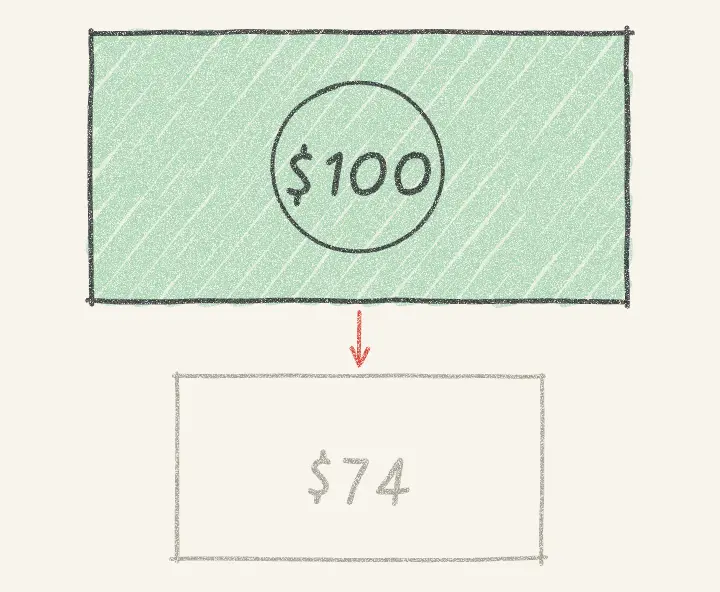
Inflation means prices rise over time. The same $100 buys a little less each year, even though it still says $100.
The US Federal Reserve and the European Central Bank both aim for about 2% inflation a year. It is often higher. Take 3% as an example.
At 3% a year, $100 buys after ten years what about $74 buys today. After 24 years, about half. The rule of 72 works here too: 72 divided by 3 is 24.
So what counts is the real return: what you earn minus inflation. Earn 7% while prices rise 3%, and your buying power grows about 4%.
Cash in a drawer earns nothing, so at 3% inflation it quietly shrinks by about a quarter every ten years. Safe from falling prices is not safe from rising ones.
Quick question
Your savings account pays 1% a year. Prices rise 3% a year. What happens to your buying power?
- It grows by 1%
- It shrinks by about 2%
- It stays the same
Show the answer
It shrinks by about 2%
The real return is about 1% minus 3%. Your balance goes up, but what it can buy goes down by roughly 2% a year.
Keep this one
Count in what money buys.
Where this comes from
The Fed and the ECB both target 2% inflation. The 3% rate and the 7% return are round examples. Buying power after n years: 100 ÷ 1.03^n.