Lesson 10 of 10 · 3 min · Mind
How to quiet your mind when the voice gets loud
All the tools from this path in one order you can use on a bad night.
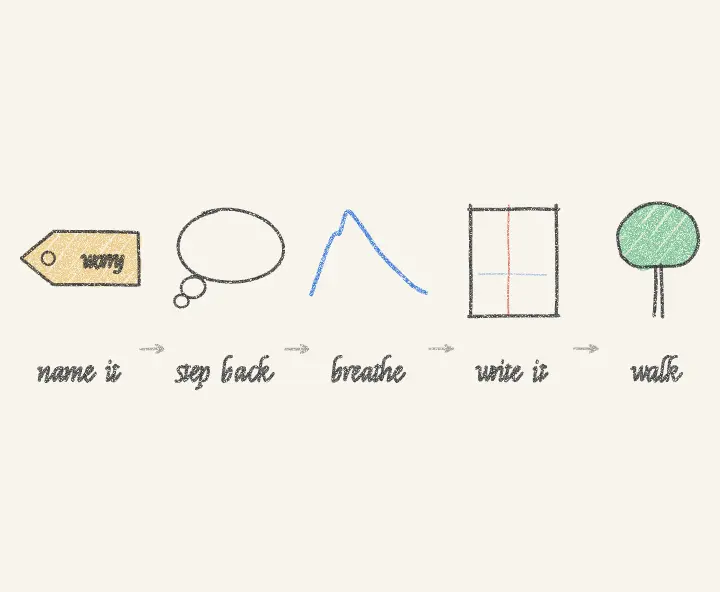
Picture the moment: it is late, something went wrong today, and the voice will not stop replaying it. Here is the whole path as one plan.
Notice and name it. This is worry. One word turns the alarm down a little.
Step back from it. I am having the thought that I ruined everything. Or talk to yourself by name: Sam, you have handled worse than this.
Breathe. Two or three cyclic sighs: in through the nose, a little more on top, a long, slow breath out.
Park it. Write down what is still open and when you will deal with it. Then close the notebook.
Move. Tomorrow, take the long way through a park and leave the phone in your pocket for a while.
These tools are for everyday noise. If the voice turns cruel and stays for weeks, or turns toward hurting yourself, talk to a doctor or a crisis line, free and open day and night: call or text 988 in the US, 116 123 in the UK and Ireland, 0800 111 0 111 in Germany.
Quick question
The voice gets loud at night. What comes first?
- Argue with the thought until it stops
- Notice it and name the feeling
- Solve every problem before sleeping
Show the answer
Notice it and name the feeling
Naming comes first because it is the smallest step and it turns the alarm down. Everything else in the plan works better from there.
Keep this one
Name it, step back, breathe, write, walk.
Where this comes from
The studies behind each step are in the lessons of this path: Lieberman and others 2007, Kross and others 2014, Masuda and others 2004, Balban and others 2023, Scullin and others 2018, Borkovec and others 1983, Bratman and others 2015.