Lesson 9 of 12 · 2 min · Valuation
Buybacks and dilution
Your slice can quietly grow or shrink.
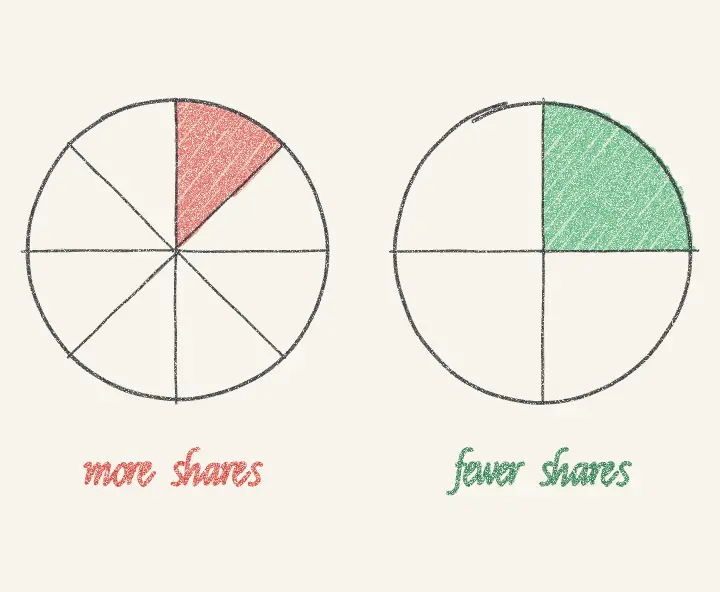
Your slice of a company depends on how many shares exist. When a company issues new shares, every old slice gets a little smaller. That is dilution.
Say Lemon Co hands its staff 50,000 new shares every year. That is 5% more shares, so profit per share grows 5% slower than profit itself.
A buyback works the other way. With its $1.2 million of free cash, Lemon Co could buy back 40,000 of its own shares at $30. Every remaining share owns a little more.
But buybacks only create value when the shares are cheap. Buying back stock that is worth $20 for $30 destroys money, just more quietly than a bad acquisition.
So always check the share count over several years. Falling is usually good news. Rising steadily is a cost to you, even if profit looks great.
Quick question
A company’s profit grows 10% a year, but it issues 8% more shares every year. How fast does profit per share grow?
- About 10%
- About 2%
- About 18%
Show the answer
About 2%
The profit is shared by 8% more shares each year, so each share gets only about 2% more.
Keep this one
Count the shares, not just the profit.
Where this comes from
Share counts are reported every quarter in the company’s filings. Lemon Co is invented for teaching.