Lesson 7 of 10 · 3 min · Mind
A to-do list before bed and a worry window: out of your head
A head is a bad place to keep a list. Two small writing habits that let it rest.
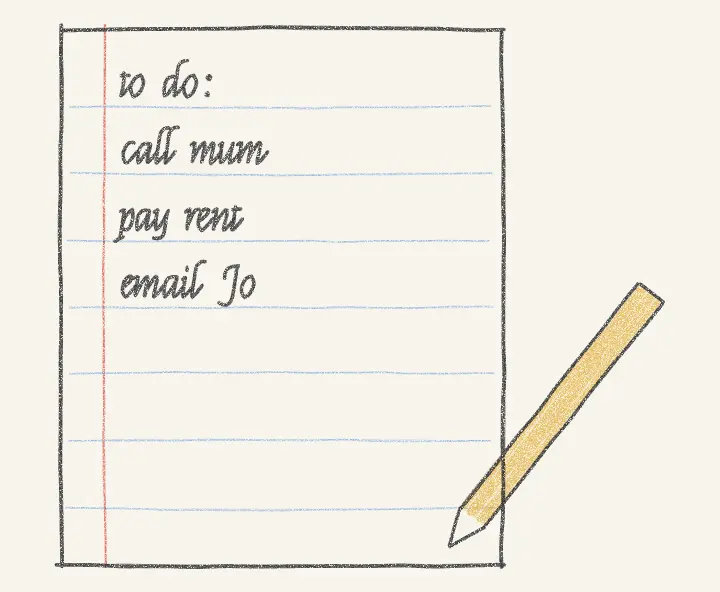
Unfinished tasks keep tugging at the mind. You lie down and remember the email, the bill, the call. Writing them down tells the mind they will not get lost.
In a 2018 sleep lab study, 57 young adults spent five minutes before bed writing either a to-do list for the next few days or a list of things they had already done. The to-do writers fell asleep about nine minutes faster.
Within the to-do group, the more people wrote down, the faster they fell asleep. So be specific: not work stuff, but email Jo about Friday, pay the gas bill.
For worry, try a worry window. In a 1983 study, people who worried a lot set aside 30 minutes a day, at the same time and in the same place, to worry on purpose and look for solutions. When a worry came up at other times, they put it off until the window.
Over four weeks, their daily worrying fell more than in a group without the plan. Worry gets a time and a place of its own, and the rest of the day gets a little quieter.
Tonight, five minutes, one page. Everything still open goes on the list, as specific as you can make it. Then close the notebook and leave it outside the bedroom if you can.
Quick question
In the sleep study, what helped people fall asleep faster?
- A list of what they had already done
- A to-do list for the coming days
- No writing at all
Show the answer
A to-do list for the coming days
Writing down what was still to come, as specifically as they could, helped people fall asleep about nine minutes faster than writing about finished tasks.
Keep this one
Out of your head, onto the page.
Where this comes from
Scullin, Krueger, Ballard, Pruett and Bliwise 2018, Journal of Experimental Psychology: General 147 (The effects of bedtime writing on difficulty falling asleep). Borkovec, Wilkinson, Folensbee and Lerman 1983, Behaviour Research and Therapy 21 (Stimulus control applications to the treatment of worry). Bar heights in the drawing are an illustration.