Lesson 2 of 5 · 3 min · Reports
The balance sheet
A photo of one day: what the company owns, and who paid for it.
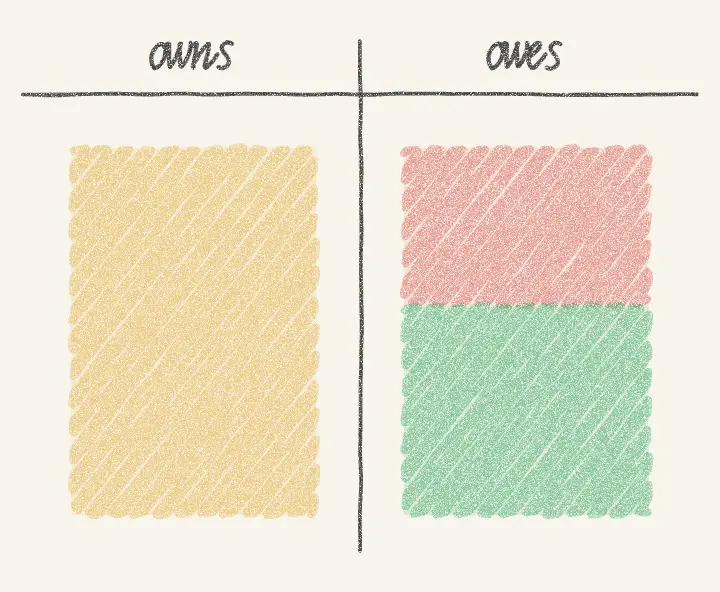
The income statement covers a whole year. The balance sheet is a photo of a single day. On the left, what the company owns. On the right, where the money for it came from.
Lemon Co owns stands and equipment worth $11.5 million on its books, $1 million of lemons in stock and money owed by customers, and $1 million in cash. $13.5 million in all.
Who paid for it? Lenders put in $6 million of debt. The owners’ part, called equity, is the rest: $7.5 million. The two sides always match. That is why it is called a balance sheet.
This is where the numbers in earlier lessons came from. Debt minus cash is net debt, $5 million. Equity plus net debt is the capital the business runs on, $12.5 million.
What to check: is debt growing faster than the business? Is cash shrinking year after year? And beware of goodwill, a large asset from past takeovers that is not something you can sell.
Quick question
A company’s assets are $100 million and its debt is $70 million. How big is the owners’ equity?
- $170 million
- $30 million
- $100 million
Show the answer
$30 million
Assets are paid for by debt plus equity. $100 million minus $70 million of debt leaves $30 million for the owners.
Keep this one
What it owns equals what it owes plus yours.
Where this comes from
The accounting identity: assets = liabilities + equity. Lemon Co’s balance sheet is simplified and invented for teaching.