Lesson 5 of 5 · 3 min · Filings
The Altman Z-score, explained
The Altman Z-score: five ratios from the balance sheet that warn of trouble with debt.
In 1968 Edward Altman took 66 manufacturers: 33 that had gone bankrupt between 1946 and 1965, and 33 that had not. He looked for the few numbers that best told the two groups apart.
He found five ratios, each measured against the company’s size: working capital, profit kept from past years, operating profit, the stock market value against the debts, and sales. Weighted and added up, they give one number, Z.
Above about 3, the companies in his study were safe. Below 1.8, they had failed. In between lay a grey zone. One year before bankruptcy, the score sorted 95% of his sample correctly. Two years before, 72%.
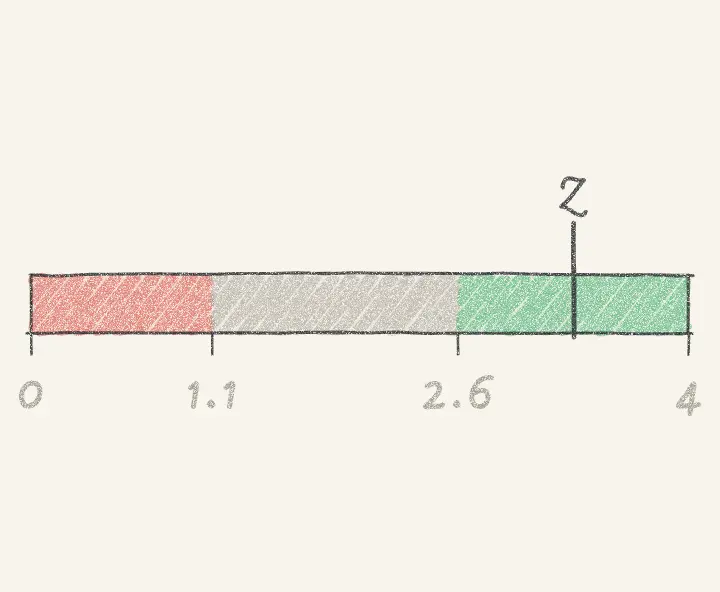
That first model was built on factories. A later version, Z″, drops sales, because a software firm and a steel mill turn assets into sales at very different speeds. Its usual lines are 1.1 and 2.6. This is the version Ryufin shows.
Lemon Co has $2 million of cash, lemons and money owed to it, and no bills due this year. $3 million of its equity is profit kept from past years. Against $13.5 million of assets, and with a market value of $30 million against $6 million of debt, its Z″ comes to about 8.2: deep in the safe zone.
Use it as a smoke alarm, not a verdict. It was built on industrial companies, so it says nothing useful about banks, and steady businesses with heavy debt, like utilities, can score low for good reasons.
Quick question
A company’s Z″ score is 1.5. Where does it sit?
- Safe zone
- Grey zone
- Distress zone
Show the answer
Grey zone
On Z″, below 1.1 is the distress zone and above 2.6 the safe zone. 1.5 sits in between: a reason to look closer at debt and cash, not a verdict.
Keep this one
Five ratios, one number: a smoke alarm for debt.
Where this comes from
Altman 1968, Journal of Finance (66 manufacturers, 1946 to 1965; 95% correct one year before failure, 72% two years before). Altman 2000, Predicting Financial Distress of Companies: Revisiting the Z-Score and ZETA Models (Z″ weights 6.56, 3.26, 6.72, 1.05). Lemon Co is invented for teaching.